
Every unit, from the dock to the receipt.
Every tag read lands in the POS: receiving, counts, transfers and checkout on one record. No middleware, and the readers and tags are yours to choose.
RFID provides the signal. We turn it into action.
Hold an RFID tag up to the light. You can see it: a set of fine lines, that's the antenna, connected to a tiny chip. That chip stores a number, permanently. No battery required. It just needs a burst of energy from an RFID reader, a gun, a pad, a scanner, to wake up and transmit its ID.
That ID is an Electronic Product Code
Unlike a barcode, which identifies an item that can have many units, an EPC identifies a specific unit of the item.
One UPC, ten EPCs
Say you have ten identical shirts on a shelf: one UPC, but ten different EPCs. Scan them all at once, and that's your count of ten, instantly.
You've seen this at self-checkout
Place your units in a bin and the cart appears on screen automatically. Readers inside the bin blast the tags with energy, capture each EPC, and the system builds the transaction. Again, instantly.
One unit. One record.
Follow a single unit through every step that touches it.
No manual counts. No assumptions.
The journey starts at the loading dock. Units arrive either pre-tagged at manufacturing, or they are tagged here, a process called commissioning. Each tag is printed, applied, and linked directly to the exact unit being received.
- A portable RFID scanner captures every EPC in the shipment at once
- Our system cross-checks what was expected against what actually arrived, at the unit quantity level
- Just verification from the very start
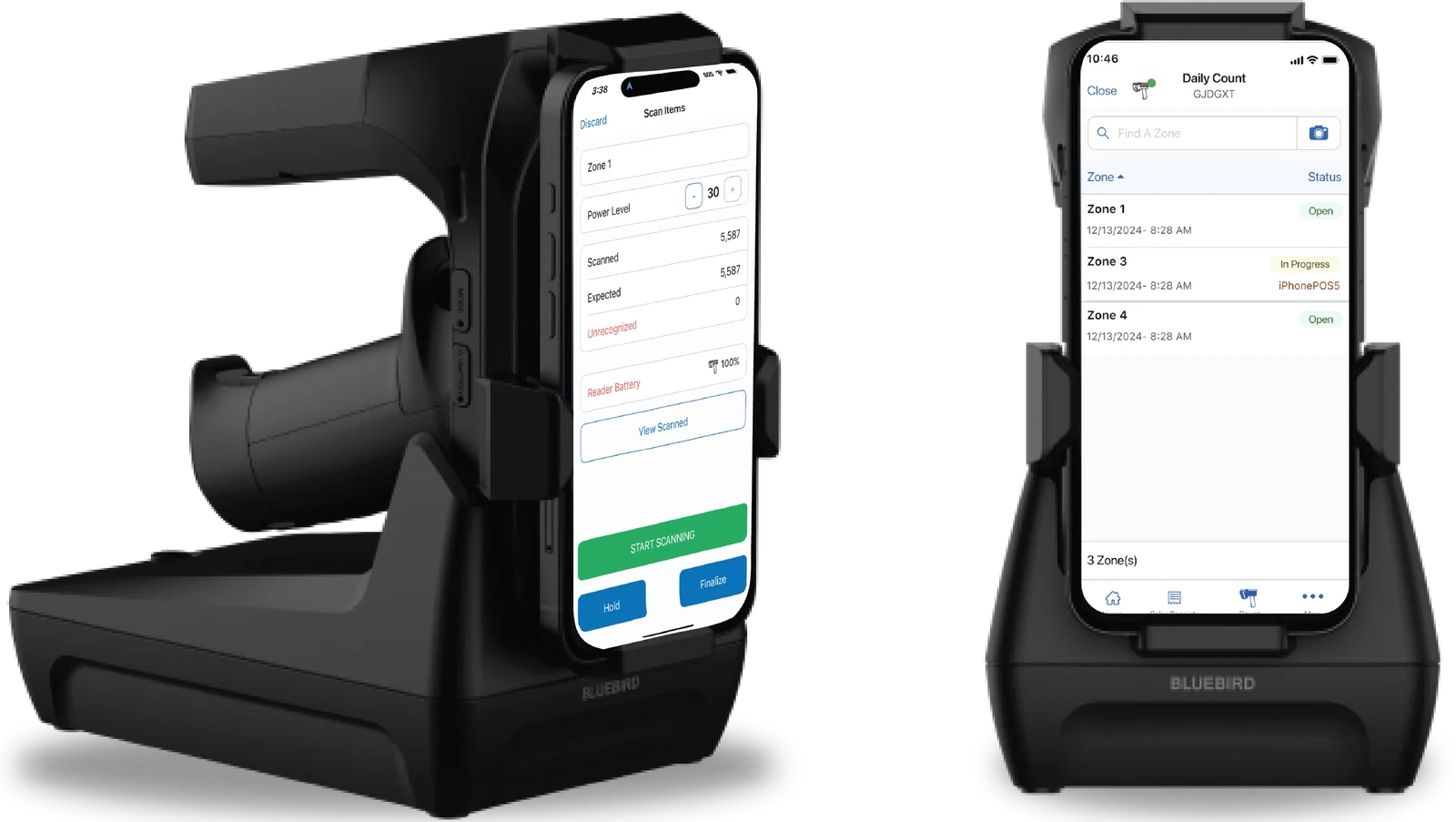
Track the exact units transferred.
As inventory moves between locations, RFID lets us track the exact units transferred. Targeted RFID-reading captures only the units directly involved in the transaction, so nearby stock isn't accidentally included.
- Our system verifies each EPC at both the source and the destination of the transfer, recording the full movement history
- Instead of guessing, retailers have a clear, unit-level audit trail
- The kind of confidence in inventory data that enables smarter replenishment decisions across stores
Whether checkout is handled by staff or by the customer.
Instead of scanning each unit's barcode one by one, everything is placed on a read zone and accurately identified instantly. In a staff-led environment, units are read at once, the cart is built automatically, and your team stays focused on service and recommendations.
- In self-checkout, customers place their units in the read zone. All units are identified instantly, the cart is built, and the customer is guided through seamlessly: no lines, no waiting
- Either way, same result: faster checkout, accurate receipts, and accurate real-time inventory
Hours with a large team, or minutes with a single person.
After units have been received, moved, and sold, RFID stock counts verify that everything is where it should be. Counts work by capturing all visible EPCs within range of the reader. Teams can scan the store, covering entire departments in seconds.
- What used to take hours with a large team can now be completed in minutes with a single person
- Instead of periodic snapshots that often get skipped, inventory can be continuously verified
- A living, always-current picture of what's in stock

Two missions that pull in opposite directions.
Never promise what you do not have. Never fail to offer what you do. Miss either one and the cost lands on the same customer.
When the site oversells
The site sells a unit the shelf does not have.
- The order is canceled after the customer has paid
- A refund, an apology, and a shopper who now doubts the stock figure
- Every subsequent promise on the site is worth less
When the shelf goes unsold
The shelf holds a unit the site will not sell.
- Stock sits in a stockroom while the page reads sold out
- The sale goes to whoever did trust their own numbers
- The markdown at the end of the season is yours to take
Available-to-Sell your e-commerce can actually trust.
Available-to-Sell is calculated from what the system believes is on hand. Counting the floor by EPC, often, is what makes that belief true, so the number your website is selling against matches the shelf.
What can the RFID handheld actually do?
Paired readers
Two handhelds can work the same incoming or outgoing transfer at once, so a large merchandise order is read in one pass rather than split into batches.
Filtered counts
Isolate a count to targeted product variations and unrelated items filter out automatically, so a single category can be verified without sweeping the whole floor.
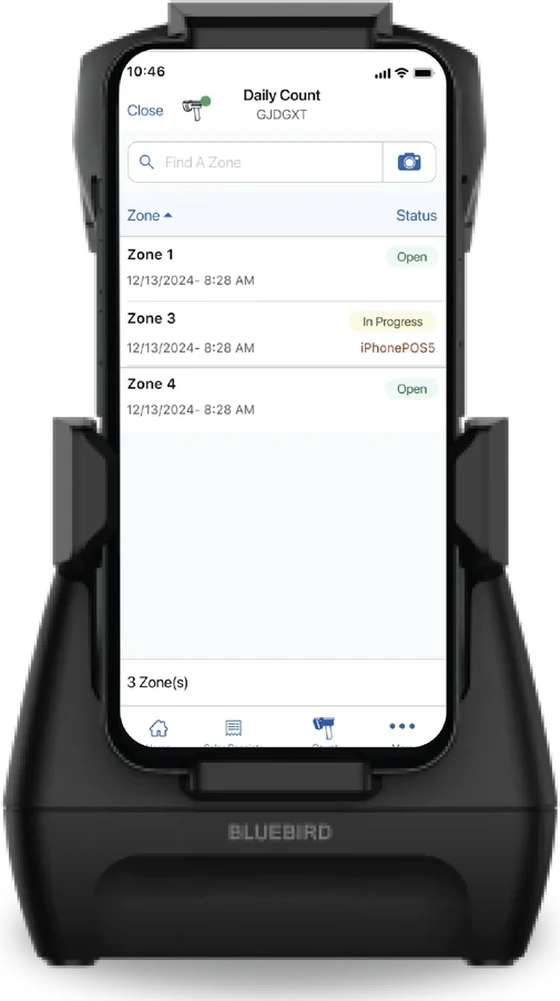
Adjustable antenna power
Scale the reader from low to high power: pinpoint one item on a rack, or sweep an entire room.
Hot-and-cold finder
A proximity meter tracks how close the reader is to a specific item, walking an associate to stock that has gone missing on the floor.
SOC 2, PCI DSS and GDPR compliant.
Independently verified against the standards your security, finance, and legal teams demand, in the markets we serve.
Bring your security questionnaire SOC 1 Type 2
 SOC 2 Type 2
 GDPR
GDPR PCI DSS
 NF525 / TSE
 ISO 27001
 MLPS 2.0 · China
RFID questions, answered.
Teamwork Commerce offers a native RFID stack that runs from tag commissioning at receiving through transfers, counts and checkout. No third-party middleware required, and the reader hardware is yours to choose. Our RFID is native to the core logic: every transaction (receiving, counting, transferring, selling) operates by individual EPC, not just UPC.
We keep a certified hardware list for clients, covering the devices integrated and supported with TW POS Pro, including Bluebird RFID handhelds. It is deliberately short, roughly one certified device per category rather than a catalogue, and there are no certified EAS gates on it today. We recommend certified hardware for full compatibility; if you want to use something not on the list, your Client Success team can advise on support.
Both. If your vendor or warehouse ships goods already tagged, they scan straight into the purchase receipt. If not, Teamwork provides an integrated encoding workflow inside the purchase receipt document: define quantity, print and encode tags, affix them, then RFID scan to populate the receipt with individual EPCs. One step, no separate process.
See every unit. Sell every unit.
Most RFID solutions give you one piece. A reader here, a count tool there. Disconnected data that doesn't talk to itself. Teamwork Commerce gives you the whole journey, from the moment a unit arrives to the moment it sells, and everything in between. One platform. Connected data. Unit-level visibility at every step.