Growth shouldn't cost
you a replatform.
What works at ten stores starts to strain at fifty: more markets, more volume, more systems, and a finance team that needs it all to reconcile. This runs underneath 30,000+ terminals in 40+ countries, including one retailer's entire 2,500-store fleet.
Already running at the size you're heading toward.
Six ways retail growth applies pressure.
Growth rarely applies in one direction. These are the six that compound, and what absorbs each one. The platform that got a retailer started is not always the one that carries them through the next stage.
Store four hundred behaves like store one.
Fleet-wide configuration is set centrally, so opening a location is a configuration task rather than a project. Promotion rules, pricing, permissions, and reporting all inherit from head office.
- Regional promotion groups and rules configured once, inherited everywhere
- Matrixed security rights across hundreds of individual corporate actions
- Employee profile transfers tracked when staff move between locations
- Unified reporting over the whole fleet, not per-store exports stitched together
Entering a new market on the same platform.
Fiscal and payment requirements are handled inside the platform rather than by a local vendor per territory, which is what usually turns international expansion into a series of one-off implementations.
- Automated fiscal compliance across 40+ countries: VAT, GST, NF525, TSE
- Multi-currency and multi-language, configured per market
- Regional payment methods natively: integrated merchant platforms and QR-based mobile wallets, configured per market
- Real-time tax calculation against the destination jurisdiction on shipped orders

Holding up through peak trading.
Throughput and resilience are properties of the architecture, not of the network you happen to have that day. Selling continues when connectivity does not.
- Every terminal stays fully operational through an outage, holding transactions locally, encrypted, and syncing on reconnect
- RFID self-checkout completes a basket in 30 seconds or less, with no item-by-item scanning
- Full-store counts in about 20 minutes instead of 24–48 labor hours
- Add or remove terminals as demand moves, a pop-up counter or 20+ positions across a venue

Scaling the people, not just the stores.
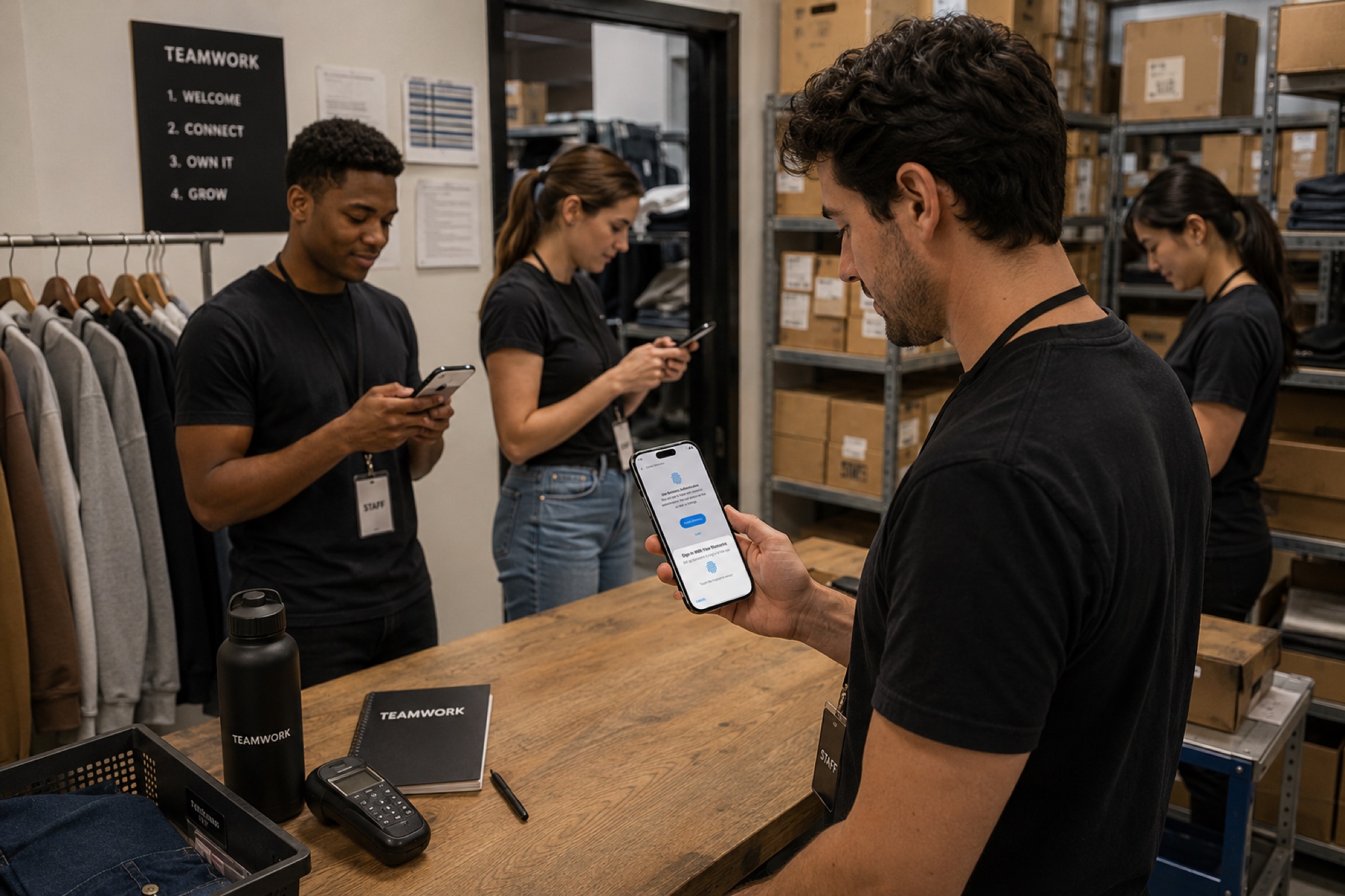
Headcount grows with store count, and turnover never stops. Getting a new associate signed in and on a device has to be a property of the system rather than a manager's afternoon.
- Rotating QR sign-in on any device, with optional facial recognition where a retailer chooses to enable it
- Company-owned and personal devices governed side by side, with policy per device type
More capability without more moving parts.
Every new requirement tends to arrive as another app, another connector, another workaround, and each one is a thing that can disagree with the others. Capability should not cost you a longer list of systems to keep in sync.
- POS, inventory, OMS and store operations share one operational foundation rather than syncing toward each other
- Transfers, counts, BOPIS and store workflows read and write the same inventory record, so there is no reconciliation step between them
- Native RFID with no middleware layer to license, host or upgrade
- New capability arrives as part of the same platform, not as an integration project

Finance needs the numbers to agree.
At a certain size the finance team becomes as important an audience as the sales floor. Transactions, tender, returns and inventory movement all have to land in the ERP cleanly enough that nobody rebuilds the month in a spreadsheet.
- Live ERP integrations with SAP, Oracle, Microsoft Dynamics and NetSuite, alongside accounting integrations into the same back office
- Automated reconciliation with standard deposit logs, plus the fiscal summaries each market requires
- Tender, returns and inventory movement recorded against one record, so store and finance are reading the same numbers
- 150+ pre-configured reports out of the same data, with no separate reporting warehouse to maintain
Proven at this scale today.
Our largest single deployment is a global apparel retailer running its entire international fleet on Teamwork Commerce.
Every store and market on the same codebase and the same upgrade path, the system described on this page.
Scale without a second platform to maintain.
Markets and brands need to behave differently. That divergence should be configuration hanging off one codebase, not a second codebase to maintain forever.
Every branch is still the same platform. One upgrade reaches all of them.
SOC 2, PCI DSS and GDPR compliant.
Independently verified against the standards your security, finance, and legal teams demand, in the markets we serve.
Bring your security questionnaire SOC 1 Type 2
 SOC 2 Type 2
 GDPR
GDPR PCI DSS
 NF525 / TSE
 ISO 27001
 MLPS 2.0 · China
Scaling questions, answered.
The platform runs across more than 30,000 terminals in over 40 countries. Our largest single-customer deployment is a global apparel retailer running more than 2,500 stores in 25-plus markets. Deployments range from that international fleet down to single-venue and pop-up operations on the same system.
Fiscal compliance is built into the platform for more than 40 countries, covering requirements such as VAT, GST, NF525, and TSE, with multi-currency and multi-language configured per market. Regional payment methods are handled natively, including integrated merchant platforms, QR-based mobile wallets, and market-specific flows such as digital invoicing in China and installment selection in South Korea. Entering a market is a configuration exercise rather than a separate implementation with a local vendor.
The POS keeps every terminal fully operational during a network outage. The app and its data sit on the device, so transactions are held locally, encrypted, and synced automatically when connectivity returns. For throughput, RFID self-checkout completes a basket in 30 seconds or less with no item-by-item scanning, and terminals can be added or removed as demand moves.
Yes. Custom services integrate through external APIs and logic overlays without altering the core POS codebase, and the interface itself is configurable, module sequence, order, and exposure are set per retailer. Because the capability set runs on one codebase rather than a collection of integrations, there is a single upgrade path instead of a regression cycle for every connected app.
The iOS interface brings associate training to under 30 minutes, and the Colorado Rockies put new seasonal associates on registers within five minutes of starting.
See it on your own numbers.
Tell us how many stores you run and what you are replacing, and a technical specialist will walk you through the platform against your actual operation, no generic demo.
- A working session, not a slide deck
- Straight to a technical specialist who knows retail
- Your details stay with us, no list sharing
Plan the next hundred stores.
Bring your rollout (store count, markets, peak volume) and we will walk through how it runs.